
Understanding Athens County Releases
For Athens County, “released” is not one status. Southeastern Ohio Regional Jail, or SEORJ, may end its custody because a person posts bond, receives a recognizance order, completes a local term, gets credit for time served, or has a case dismissed. The same departure may instead be a transfer to the Ohio Department of Rehabilitation and Correction, another jail, a federal agency, or immigration custody. Only the first group clearly describes a return to the community. A transfer record proves that SEORJ custody ended, but another custodian then took control.
The regional jail’s online report is a current “New Inmate Roster.” A released person normally falls off that list. Absence is only a starting clue because the roster does not state why a record disappeared. The reliable record comes from the jail that processed the departure, the Athens court that supplied the legal authority, and, when applicable, the receiving agency. Those sources also distinguish the court’s order date, the jail’s physical release time, and the start of supervision. The three dates can differ.
Athens County Release Paths
The next search depends on the disposition recorded by SEORJ and the court. “Current Disposition” beside a charge on the live roster is not an official release reason, and Total Bail does not prove that anyone posted bail. Ask for the actual release or transfer code before choosing the next database.
| Path | What it means | Next source |
|---|---|---|
| Bond or recognizance | The court authorized release while the case continues. | SEORJ release record and Municipal or Common Pleas docket |
| Time served or sentence complete | The local confinement term ended, subject to any other hold. | Release time plus signed sentencing entry |
| Dismissal or court order | The named case no longer supports custody, though another case may. | Signed court entry and jail hold check |
| ODRC transfer | The person left the county jail but entered state custody. | ODRC Offender Search |
| Outside or ICE hold | Custody passed to another agency rather than the community. | Receiving agency, ODLS, BOP, or the relevant court |
Probation and parole are different. Probation, often called community control in Ohio court records, is imposed by a court. Parole and post-release control follow state confinement and involve the Ohio Adult Parole Authority. Release from a building does not necessarily end the sentence.
Athens County Release Record Fields
A release record may be called a booking/release sheet, jail card, custody-status history, release screen, or log entry. Request the underlying record instead of asking the office to answer a broad question. Useful identifiers include the full name, Jail ID if known, booking date, arresting agency, and court case. The following fields make the result easier to interpret.
| Field | What it establishes |
|---|---|
| Booking and Jail ID | Links the departure to the correct SEORJ custody episode. |
| Release date and time | Shows when the jail actually ended that episode. |
| Release type or code | May identify bond, court order, sentence completion, or transfer. |
| Releasing facility | Identifies which custodian created the event. |
| Receiving agency or destination | Distinguishes community release from continued custody elsewhere. |
| Booking photograph | May be a separate record series and should be requested separately. |
A court docket adds the legal basis: bond orders, pleas, journal entries, sentencing, jail-time credit, community-control orders, warrants, or termination. It may not show the precise minute that SEORJ opened the door. ODRC records use different fields, including Status, Expected Release Date/Parole Eligibility Date, POA/PRD, Parole or Release Detail, and Supervision Start or End. Not every state record contains every field.
Request Athens County Release Records
Begin with the office that created the record. For a SEORJ event, contact the jail at its official contact page or 740-753-4060. The Athens County Sheriff can route Athens arrest records at 13 W. Washington Street, Athens, Ohio 45701, 740-593-6633, Monday through Friday from 8 a.m. to 4 p.m. The Athens County Records Center Form A-4 page is a fallback for county records held there, but it does not prove the center holds every regional-jail file.
- Name the exact record: booking/release sheet, custody history, release log entry, disposition code, receiving agency, or booking photo.
- Give the person’s full name, booking date, Jail ID, arresting agency, and case number when known.
- State the date range and ask for electronic delivery if that format works.
- Ask the custodian to cite any redaction or denial and to provide separable public portions.
- Compare the response with the signed court entry and any receiving-agency record.
No fixed SEORJ fee, turnaround, or booking-record retention period was verified. Ohio law allows actual copying and delivery cost, while the agency’s approved retention schedule controls how long a record remains. Web removal is not the same as lawful destruction. Ask for the RC-2 series and retention period if age matters.
Ohio Law on Athens Releases
Ohio Revised Code §149.43 generally calls for prompt inspection and copies within a reasonable time. A requester ordinarily need not give a name or purpose. Exemptions can protect medical details, confidential investigatory material, victim identifiers, juvenile files, specified supervision information, sealed records, and security material. An office should separate releasable material and explain withheld portions.
Sealing and expungement under Chapter 2953 depend on the offense, case history, order, and current law. A sealed docket may no longer be public, but an online roster’s earlier removal alone does not prove sealing. Retention schedules under Ohio law remain distinct from publication choices. Use the issuing court’s certified order when seeking correction or restricted access from another custodian.
Find Released Athens County Inmates
Use the last known custodian as the starting point. A single name can appear in several systems, and SEORJ serves five counties. Always match the arresting agency, court, booking date, and identifier before drawing a conclusion.
- Check the official SEORJ inmate-information bridge and its current roster. If listed, the person was in SEORJ when the report ran.
- If absent, request the actual SEORJ release or transfer record. The 24-Hour Releases page explains why there is no official daily release feed.
- Read the Athens Municipal or Common Pleas docket for the bond, dismissal, sentence, transfer, or other legal basis.
- If the jail record names ODRC, search state status and dates. Use Release Date Lookup for date-field limits.
- For federal or immigration custody, move to BOP or ICE rather than repeating the county search.
A name missing from the live jail roster does not prove community release. It can reflect transfer, court movement, another hold, or a data update.
ODRC Search for Athens Releases
The Ohio Department of Rehabilitation and Correction Offender Search covers people in the state corrections system. It is not a county-jail archive. Search by name, offender number, county of commitment, residential county, ZIP code, status, or next parole-board hearing month. Status choices include Incarcerated, Released, APA Supervision, and Violators at Large. A person transferred from SEORJ to prison may appear as incarcerated even though the county roster no longer shows the name.
| Search field | Best use |
|---|---|
| Name | Start broad, then match identity and cases. |
| Offender number | Separates people with similar names. |
| Status | Distinguishes confinement, release, and APA supervision. |
| County of commitment | Narrows sentencing origin, but may omit another relevant county. |
| Hearing month | Finds a parole-board cohort, not a promised release date. |
The public ODRC definitions explain Expected Release Date/Parole Eligibility Date, POA/PRD, judicial release, and supervision fields.
The official search form shows how Ohio separates status and identity fields.
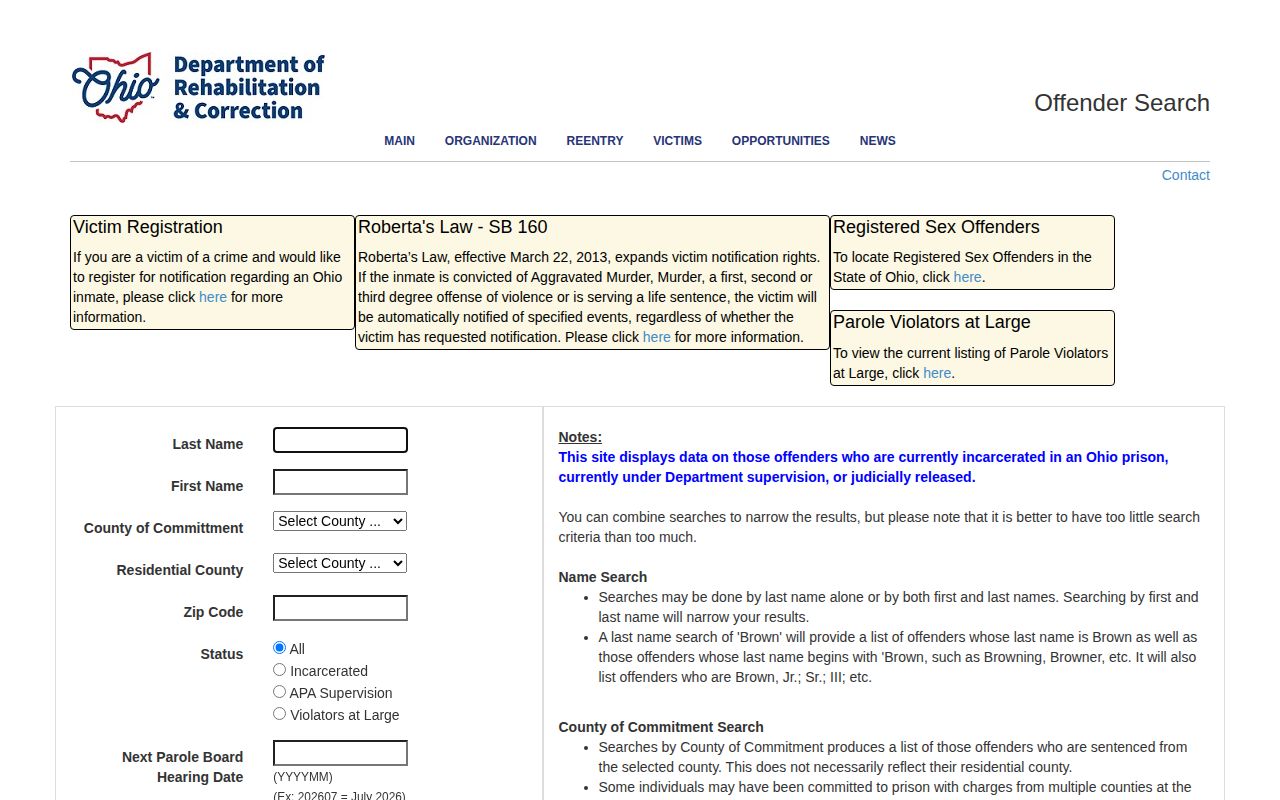
Match its result to the sentencing docket before treating a date or status as final.
Athens County Recent Release Limits
No official 24-hour or 72-hour Athens County release list was found as of July 31, 2026. The JDS page linked by SEORJ is timestamped and labels itself “New Inmate Roster.” It presents current entries with Jail ID, name, photo, charges, court, disposition, bail, SID, book date, attorney, next court date, and arresting agency. It has no released filter, release date, release reason, or archive control. Do not turn a comparison of yesterday’s and today’s rosters into a release list.
For a named person, call SEORJ and ask for the custody history. For a three-day period, request an existing release log for that exact range if one is maintained. VINELink can report a custody change from participating agencies, yet the alert should still be confirmed with the custodian.
Athens Post-Release Supervision Check
ODRC’s Status and APA fields can show parole or post-release control after prison. The supervising office and start or end dates may appear on the offender detail. Athens County probation or community control instead comes from the sentencing court, so examine the judgment and contact the court’s probation office. “Released” from a jail, prison, or residential program does not automatically mean “discharged” from every legal obligation. The Post-Release Supervision page separates these paths and explains parole-board results.
Athens Release Alerts and Transfers
Ohio VINELink allows a specific-person search and notification registration for events offered by a participating source. Match the agency and identifier. A released or out-of-custody alert reports a feed event, not the legal reason or destination. Save the alert, call the named custodian, and request the record. The VINE Inmate Check page explains registration and the confidential PIN used for phone alerts.
The BOP Inmate Locator covers many federal records from 1982 onward. ICE’s Online Detainee Locator System is aimed at current custody and can retain some release information briefly; it is not a permanent release archive. The U.S. Marshals Service has no equivalent public historical release locator. Use the federal court docket or agency records process when the locator no longer answers the question.
Where Athens Release Status Appears
Choose the source that matches the custody type and the question being asked.
| Source | What it supports | What it cannot prove alone |
|---|---|---|
| SEORJ current roster | Regional-jail custody at the printed run time | Why an absent person left |
| SEORJ release record | Actual end time, code, and destination when recorded | Final outcome of every court case |
| Athens court docket | Bond, sentence, dismissal, transfer, or supervision authority | Exact physical release minute |
| ODRC search | State confinement, released status, dates, or APA supervision | A purely local jail release |
| BOP or ICE locator | Federal or immigration custody within its stated coverage | A county release or permanent history |
Getting Home After Athens Release
SEORJ is in Nelsonville, not downtown Athens. Athens Public Transit serves Nelsonville, but no official source confirms service at the Riverside Drive entrance or a pickup point at the release door. Consult the current HAPCAP rider guide, then call transit and SEORJ before arranging a ride. The Sheriff’s transport unit moves people under court or warrant authority between courts, SEORJ, prisons, and other jurisdictions. That service is not a ride home after community release.
Athens Court Events and Release
Athens Municipal Court publishes a bail schedule and holds criminal and traffic arraignments on court days, sometimes by video from SEORJ. A bond order can lead to release, but it is not acquittal or case completion. The signed order explains legal authority, while the jail record supplies the actual departure time. A later hearing, amended charge, warrant, or sentencing entry can change what happens next. Readers checking a same-day departure should match the roster’s court field to the docket and avoid treating the bail amount as proof that payment occurred.
Which Athens Release Court Applies?
Athens keeps separate docket portals. Municipal eServices covers misdemeanors, traffic matters, and early felony activity. Common Pleas CourtView preserves felony indictments, sentencing, prison commitments, judicial release, community control, and termination. A felony can begin in Municipal Court and continue in Common Pleas, so a search of only one portal may stop before the decisive release event. Sealed matters will not remain available in the same public form. When online detail is incomplete, request the relevant journal entry from the clerk rather than guessing from a docket label.
Support After an Athens Release
The Sheriff-led H.E.A.R.T. program offers care navigation for people and families dealing with addiction or overdose. It can be reached by phone, email, web request, or walk-in. STAR Athens Campus also builds an aftercare plan before program release. Neither resource verifies custody. They address local support after the release status has been confirmed.
Athens ICE Holds After Jail
An ICE detainer can turn the end of SEORJ custody into a transfer rather than a community release. No Athens County ICE detention center or verified SEORJ detention contract was found. ICE assigns Athens County check-in matters to its Columbus field-office system, but a reporting office is not proof of detention there. Ask SEORJ for the receiving agency, then use ODLS and the ICE information line as appropriate.
Why Athens Facility Names Change
Local records can use two very different Nelsonville facility names. SEORJ opened in 1998 as a five-county regional jail. STAR Community Justice Center’s Athens Campus is a separate residential correctional program formerly called SEPTA Correctional Facility. A cited Ohio appellate decision records that SEPTA dissolved as a legal entity on July 1, 2019, when the site became STAR’s Athens Campus. Older court entries may still say SEPTA. Search both names for an older placement, but do not merge STAR records with the SEORJ roster. Leaving STAR may end residential placement while community control continues.
Athens County Release Facilities
Southeastern Ohio Regional Jail is the verified regional jail for ordinary Athens County adult commitments. Opened in 1998, it serves Athens, Hocking, Morgan, Perry, and Vinton Counties, so its arresting-agency and court fields matter. STAR Community Justice Center, Athens Campus is a separate community-based correctional facility for adult men. It was formerly called SEPTA. Completion or termination there must be checked in the sentencing docket and probation record. No operating ODRC prison, BOP institution, or identified ICE detention center was verified inside Athens County.
The Athens County Sheriff’s administrative office is not a second jail. Its official contact page says Athens prisoners are housed at SEORJ and directs detention inquiries to the regional facility. Likewise, a person sentenced from an Athens court is not automatically assigned to an Ohio prison inside the county. ODRC chooses the institution, and the statewide offender record is the correct way to follow that transfer.
Athens Release Records After Removal
The disappearance of an entry from a public website says little about the government record’s life. SEORJ’s current roster has no historical control, while the Athens County Records Center stores semi-active and inactive files for participating county departments and offers appointment-based access. Start with SEORJ for a record it created. If that office routes an older county-held record elsewhere, the Records Center and Form A-4 provide a documented next step.
Ask the custodian for the title of the retention schedule and the record series that covers booking, release, custody history, or photographs. No single Athens or SEORJ retention period was verified, so a fixed number would be misleading. Legal holds, sealed cases, exemptions, and approved schedules can affect access. A denial should identify its basis, and public portions should be separated when the law permits. Preserve the response with the court order because later web searches may show less than the agency file.